World Energy Crisis Related News
Energy crisis related material in undigested form.
Most recent is on top.
 Suggestions for inclusion here are
welcome. Click the icon or e-mail me at Suggestions for inclusion here are
welcome. Click the icon or e-mail me at
jack@planetforlife.com
Posted June 2010

Hello jack,
Just wondering if you accept guest posts? I’d
love the opportunity to submit an article I wrote.
Based on some of the content on your site, I figured
you’d be interested in one that pertains to
energy efficiency and green initiatives. I believe it
would be well suited for your readers at
(planetforlife.com). While my intentions are to
highlight a topic of my choice in order to bring
awareness to the content covered (for instance, World
Environment Day, World Ocean Day, green businesses,
energy efficiency and sustainability tips, etc
– I loved my renewable energy classes!),
I’d be open to suggestions for edits - just in
case you needed something a little different than
what I have to offer. Let me know if this is possible
and I can send along an article for your review.
Thank you in advance for your consideration.
Best regards,
Marcus Reyes
The article is here in Adobe PDF
form or Microsoft DOC form.
Thank you, Marcus
Posted June 2010
This is from an 11 year old girl who has made a
movie. She says it "would be a great thing to put
on your website since its from a kid's
perspective."
If the movie does not run, it is probably because you
need to download a Quicktime media player.
Thank you, Lauren
Posted July 2005
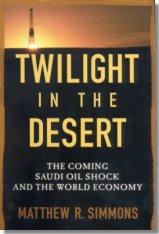 Twilight in the
Desert Twilight in the
Desert
The Coming Saudi Oil Shock and the World
Economy,
by Matthew Simmons
(Reviewed by Planetforlife)
Do you think that Saudi Arabia can open a few valves
or drill a few more wells to provide more oil? This
book will disabuse you of that notion. The Saudi
government has repeatedly assured the world that it
has huge reserves and that oil exports can be easily
increased. Simmons disputes this. According to
Simmons, Saudi Arabia finds it increasingly difficult
to produce oil at the present rate, let alone
increasing production to satisfy increasing
demand.
The Society of Petroleum Engineers (SPE) has 64,000
members from 115 countries. SPE technical papers are
available online at http://www.spe.org These
papers are peer-reviewed and meet high scientific
standards. Twilight in the Desert is based on
Simmon's reading of 200 plus SPE papers published
between 1961 to 2004. Many of the papers were written
by Saudi engineers.
Simmons has an MBA from Harvard but he seems to know
oil geology as well as an oil geologist. He founded
Simmons Company International http://www.simmonsco-intl.com/
Go to "Simmons News" to read what he said March
2003 when he testified before the Senate Committee on
Energy and Natural Resources. Simmons was also an
advisor to Vice President Cheney’s Energy Task
Force in 2001.
The publisher of Twilight in the Desert is John Wiley
& sons http://www.wiley.com/WileyCDA/
which was founded in 1807. As of June 2005, Amazon
ranks this book #38 in sales.
Here is a summary of the book beginning with facts
and numbers and a little oil geology. The world
consumes about 80 million barrels of oil each day and
Saudi Arabia supplies nearly 10 million of that. Just
one oil field, Ghawar, produces 4.5 million and it
has been a major producer for more than a half
century. Just three other fields, Abqaiq, Safaniya
and Berri supplies most of the rest. It is impossible
to overstate the importance of Ghawar.
Oil in an oil field reservoir is under pressure. As
the oil field produces oil, the pressure gradually
decreases. When the pressure is released, dissolved
gas bubbles out of the oil. The same thing happens
when you open a soft drink or can of beer. The
pressure at which the oil bubbles is called the
bubble point and it can not be allowed to happen. The
gas forces oil away from the wellhead and stops the
flow of oil. The effect is permanent. It is a
consequence of trying to produce oil too fast.
It is possible to maintain reservoir pressure by
pumping gas into the reservoir or by pumping water
beneath it or around the periphery. The oil produced
in this way is usually mixed with water. GOSPs (gas
oil separators) must be used. Their capacity can
limit production if the water content gets too high.
When the water "cut" gets too high, the well becomes
uneconomic and it must be shut down. A high water cut
is also indication that the well is producing too
fast. It can also mean that the reservoir is being
damaged.
The US government became aware of these problems in
Senate subcommittee closed door hearings in 1974.
Senators grilled oil company executives who then
controlled Saudi oil production. They admitted that
they consistently underestimated world oil demand.
The senators also accused the oil companies of over
producing oil before turning the responsibilities of
oil production over to the Saudis. The executive's
motives were profits. The senators feared that the
damaged oil fields would not be sufficient to supply
world oil needs back in 1974!
The content of the hearings were made public in 1974
but it never made the news. The watergate hearings
were underway at the time.
When the Saudis took control of the oil fields the
first order of business was to look for more oil
fields. They knew they had to reduce the production
of Abqaiq, Safaniya, Berri and especially Ghawar to
avoid damaging them. The most advanced technology
available was used for the search. The Saudis did not
find much.
The Saudis claim to have 260 billion barrels of oil
reserves. You can find this number in many places
including the BP Statistical Review and this website.
The Saudis claim they will be able to produce 15 or
20 or even 25 million barrels per day. These are
widely accepted numbers but they are apparently not
true.
The Saudis are pressed by a $170 billion dollar debt
and an exploding population. (The average Saudi woman
has 6.7 children.) The Saudis were forced to depend
on their old oil fields. They did this with
horizontal drilling. It is possible to drill many
holes through a reservoir without moving the drilling
rig. The drill bit can be steered to stay below the
gas cap and above the water. This is advanced
technology that can keep an oil field producing at a
high rate. But it does not increase the amount of oil
produced ultimately. This is a key point.
The SPE papers show that the Saudis were producing
oil at rates that risked damaging their oil
reservoirs in the 70s and that is true today as well.
The Saudi claim of vast reserves is apparently not
true or they wouldn't exploit their old fields to the
extent that they do.
Ghawar is the king of oil fields. If it waters out,
there will be an oil shock.
Simmons explains why he wrote this book. He notes
that Saudis themselves are either lying or in serious
denial about their own oil fields. He notes that for
years the rest of the oil industry has lazily taken
Saudi assurances at face value instead of
investigating them closely. He pleads for detailed
field-by-field reports, test-well analyses, and
exploration results that would convince everyone
they're telling the truth?
Posted January 2005
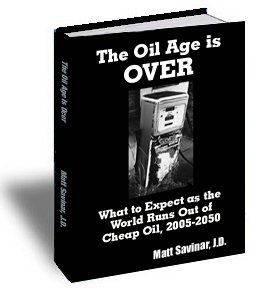 The Oil Age is OVER, by Matt Savinar. The Oil Age is OVER, by Matt Savinar.
This is what Matt has to say about his book:
Civilization as we know it is coming to an end soon.
This is not the wacky proclamation of a doomsday
cult, apocalypse bible prophecy sect, or conspiracy
theory society. Rather, it is the scientific
conclusion of the best paid, most widely respected
geologists, physicists, and investment bankers in the
world. These are rational, professional, conservative
individuals who are absolutely terrified by a
phenomenon known as global “Peak Oil.”
The ramifications of Peak Oil are so serious, one of
George W. Bush’s energy advisors, billionaire
investment banker Matthew Simmons, has acknowledged,
“The situation is desperate. This is the
world’s biggest serious question,” while
comparing the crisis to the perfect storm: “If
you read The Perfect Storm, where a freak storm
materializes out of the convergence of three weather
systems, our energy crisis results from the same
phenomenon.”
In May 2001, George W. Bush himself went on the
record as saying, “What people need to hear
loud and clear is that we’re running out of
energy in America.” In October 2003,
Bush’s nemesis Michael Moore released the book,
Dude, Where’s My Country? Chapter three of the
book, “Oil’s Well that Ends Well,”
was dedicated to the coming post-oil die-off.
If you’re like 99 percent of the people reading
this letter, you had never heard of the term
“Peak Oil” until today. I had not heard
of the term until a year ago. Since learning about
Peak Oil, I’ve had my view of the world, and
basic assumptions about my own individual future,
turned completely upside down.
A little about myself: In November 2003, I was a
25-year-old law school graduate who found out he had
just passed the California Bar Exam. I was excited
about a potentially long and prosperous career in the
legal profession, getting married, having kids,
contributing to my community, and living the
“American Dream.” Since learning about
Peak Oil, those dreams have been radically altered.
I must warn you, the information contained in this
book is not for the faint of heart or the easily
disturbed. Whether you’re 25 or 75, an attorney
or an auto mechanic, what you are about to read will
likely shake the foundations of your life.
Posted December 2004
 Oil: Anatomy of an Industry, by Matthew
Yeomans. Freelance journalist Yeomans deftly traces
the history of oil in America. He then shows that
American consumer culture has led to an addiction to
oil--an addiction which makes oil America's Achilles'
heel. He points out that American diplomacy and the
war in Iraq are mostly about oil. Oil: Anatomy of an Industry, by Matthew
Yeomans. Freelance journalist Yeomans deftly traces
the history of oil in America. He then shows that
American consumer culture has led to an addiction to
oil--an addiction which makes oil America's Achilles'
heel. He points out that American diplomacy and the
war in Iraq are mostly about oil.
The second half of his book describes a solution to
the energy dependence problem. He suggests that the
government fund research to develop energy efficient
vehicles. He also suggests that hydrogen is part of
the future. Planetforlife points out that hydrogen is
not an energy source and that it is not an optimal
energy carrier. Despite this disagreement,
Planetforlife recommends this book.
Posted September 2004
 The
September issue of National Geographic is
devoted largely to Global Warming. Here is a quote
from the editor; The
September issue of National Geographic is
devoted largely to Global Warming. Here is a quote
from the editor;
"After a decade as Editor in Chief, I have a pretty
good idea which articles will provoke a lot of angry
letters. Whenever we publish stories that challenge
widely held beliefs, some readers get mad, and they
write to let us know.
Well, we're about to do it again. We're devoting 74
pages of this issue to a three-part series of stories
on global climate change, and I'd be willing to bet
that we'll get letters from readers who don't believe
global climate change is real, and that humans
contribute to the problem. Some readers will even
terminate their memberships.
Why would I publish articles that make people angry
enough to stop subscribing? That's easy. These three
stories cover subjects that are too important to
ignore. From Antarctica to Alaska to Bangladesh, a
global warming trend is altering habitats, with
devastating ecological and economic effects.
So I'm asking you--even those of you who don't
believe the Earth is getting warmer and that human
behavior is a contributing fact--to turn to page 2.
This isn't science fiction or a Hollywood movie.
We're not going to show you waves swamping the
Stature of Liberty. But we are going to show you the
hard truth as scientists see it. I can live with some
canceled memberships. I'd have a harder time looking
at myself in the mirror if I didn't bring you the
biggest story in geography today."
http://magma.nationalgeographic.com/ngm/0409/index.html
(Here are two very good books.)
Red Sky at Morning. This book will change the
way we understand the future of our planet. It is
both alarming and hopeful. James Gustave Speth,
renowned as a visionary environmentalist leader,
warns that in spite of all the international
negotiations and agreements of the past two decades,
efforts to protect Earth’s environment are not
succeeding.
 Oil, Jihad & Destiny (Will
declining oil production plunge the planet into a
Depression?) by Ronald R. Cooke. This book does not
shy away from answering the difficult questions.
Cooke describes the effect of Islamic fundamentalism
on world oil production, for example. He has taken a
careful look at the future and his conclusions are
not colored by wishful thinking. It may be soothing
to hear a "new energy source will be found" or "we
can have energy independence" but Cooke clearly
explains the barriers to energy self-sufficiency. On
the other hand, he details a number of practical
steps we can take to avoid the chaos of oil
depletion. Oil, Jihad and Destiny ends with a
challenge. Will we respond in time? A description of
this book may be found at www.futurereality.org
Oil, Jihad and Destiny may be purchased
through www.booksurge.com or
www.amazon.com Oil, Jihad & Destiny (Will
declining oil production plunge the planet into a
Depression?) by Ronald R. Cooke. This book does not
shy away from answering the difficult questions.
Cooke describes the effect of Islamic fundamentalism
on world oil production, for example. He has taken a
careful look at the future and his conclusions are
not colored by wishful thinking. It may be soothing
to hear a "new energy source will be found" or "we
can have energy independence" but Cooke clearly
explains the barriers to energy self-sufficiency. On
the other hand, he details a number of practical
steps we can take to avoid the chaos of oil
depletion. Oil, Jihad and Destiny ends with a
challenge. Will we respond in time? A description of
this book may be found at www.futurereality.org
Oil, Jihad and Destiny may be purchased
through www.booksurge.com or
www.amazon.com
Here is a site that explains and illustrates chaos.
It is a good way to get a feeling about the science
of weather prediction and climate prediction.
http://www.exploratorium.edu/complexity/java/lorenz.html
Posted July 2004
(Here are two highly recommended books.)
The Club of Rome commissioned the Massachusetts
Institute of Technology (MIT) to perform several
studies beginning in 1968. The questions posed
include Are current policies leading to a
sustainable future or to a collapse? and What
can be done to create a human economy that provides
sufficiently for all? The results of the study
were summarized in a widely read book called
Limits to Growth which is still in print. In
2004, the same authors published Limits to Growth
The 30--Year Update. Learn more about the Club of
Rome: http://www.clubofrome.org
Stanford biologist Paul Ehrlich published The
Population Bomb in 1968--which is still in print.
The Population Bomb was widely read and the
subject of controversy. Paul and Anne Ehrlich are
coauthors of One with Nineveh published in
2004. One with Nineveh is in many ways the
sequel to The Population Bomb.
These books deal with the big question of human
overpopulation. Both books are primarily about
science. They are not speculative or political. Yet,
these books have been greeted by derision and
hostility. These critics, it turns out, are from the
far right. Hermann Kahn, founder of the Hudson
Institute, is an example. Julian Simon, an economist
and a fellow of the Cato Institute, is another
example. In 1984 Kahn and Simon coauthored The
Resourceful Earth wherein they asserted that:
- Fish catches are resuming their long upward trend
- There is no sign of climate change
- There is no evidence of species loss
These are all demonstrably incorrect assertions.
Simon and Kahn are not mere critics--they influence
the public and policy makers. Simon was one of the
architects of the Reagan administration economics
policy. Both assert that there are no limits to
growth and economic well being. This assertion has a
certain appeal but it has no scientific basis.
|
If you think that Simon and Kahn might be
correct, consider this: Human population
grows exponentially in the absence of
famine, disease, warfare, etc. If you don't
know what exponential growth means, just
remember that growth gets faster as time
passes. Now consider that the Earth is
finite. It follows that something will
limit human population. It might be fossil
fuel. It might be clean water or farm land.
There is abundant evidence that limits are
being approached.
 Nature has provided scientists
with many examples of what happens when
something limits growth. The reindeer on St
Matthew Island provide an example. When the
reindeer were introduced to St. Matthew
Island, their numbers grew exponentially
until a limit (food) was reached. Then the
population collapsed from 6000 to 4. The
number of humans grows exponentially and
someday we will encounter a limit. Unlike
reindeer, humans can anticipate problems.
Humans and reindeer are equally bound by
nature's laws. If you can refute this
argument, please contact me. Nature has provided scientists
with many examples of what happens when
something limits growth. The reindeer on St
Matthew Island provide an example. When the
reindeer were introduced to St. Matthew
Island, their numbers grew exponentially
until a limit (food) was reached. Then the
population collapsed from 6000 to 4. The
number of humans grows exponentially and
someday we will encounter a limit. Unlike
reindeer, humans can anticipate problems.
Humans and reindeer are equally bound by
nature's laws. If you can refute this
argument, please contact me.
We humans will want to practice population
control before we encounter a limit.
Learn more about the St. Matthew reindeer
here:
http://www.gi.alaska.edu/ScienceForum/ASF16/1672.html
|
Planetforlife deals with the energy problem which is
only a part of the human overpopulation problem.
Posted June 2004
Two hydrogen economy related PDF files may be found
here. In this proposal, the problems of hydrogen
storage are sidestepped by converting the hydrogen to
methane.
The June issue of National Geographic has an article
whose full title is: "Think gas is expensive now?
Just wait. You've heard it before, but this time it's
for real: We're at the beginning of the end of Cheap
Oil."
This article may be read at;
http://magma.nationalgeographic.com/ngm/0406/feature5/index.html
Posted May 2004
Colin Campbell and the Uppsala Hydrocarbon
Depletion Study Group has now made the 2004
upgrade of the peak oil model. The peak is moved from
2010 to 2008
How Global Warming May Cause the Next Ice Age,
by Thom Hartmann
http://www.commondreams.org/views04/0130-11.htm
Seppo Korpela is a professor at Ohio State
engineering school. See the links and articles
related to a Looming World Oil Crisis. His
paper, Oil Depletion in the United States and the
World, is a very good 27 page summary of the
problem. It was presented to the Ohio Petroleum
Marketer's Association.

|
 Back
Back